
Elevate Your Travel Style: Essential Tips for Versatile Outfits
The women who arrive at a dinner directly from a flight looking entirely composed are not travelling with a more expensive wardrobe. They are travelling with a more considered one."
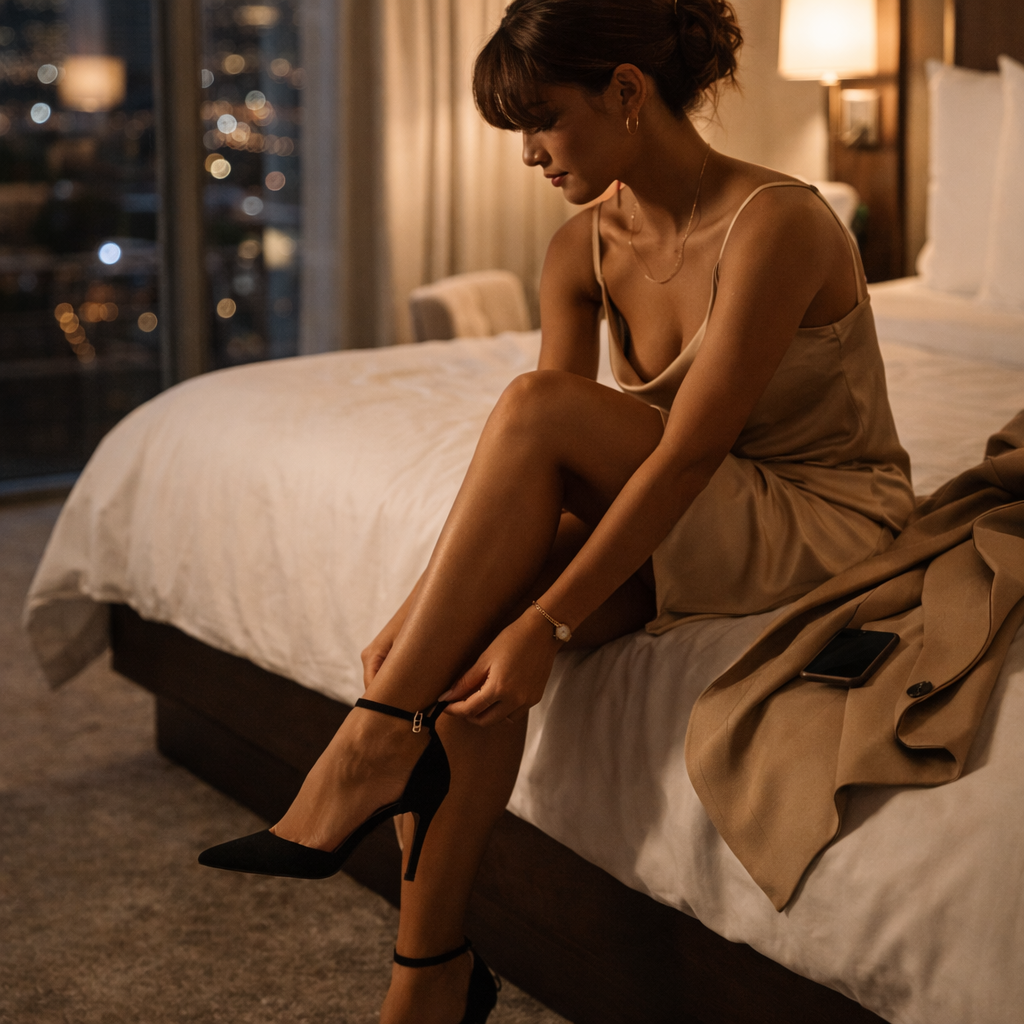
There is a specific kind of exhaustion that comes from travelling with the wrong wardrobe. Not the physical exhaustion of the bag — though that contributes — but the cognitive tax of arriving somewhere and realising that nothing you packed is quite right for the room you're about to walk into. The lounge outfit that reads too casual for the dinner. The work clothes that feel too rigid for the hotel lobby. The costume change squeezed into a Heathrow bathroom that nobody talks about but almost everyone has done.
The women who move through multiple high-quality environments in a single day have largely solved this problem. The solution is not a larger suitcase.
What the Room Is Actually Reading
The visual grammar of consequential environments — club dining rooms, premium lounges, boutique hotel lobbies, first-class cabins — has remained more consistent than fashion trends would suggest. Restraint in colour and volume. Precision in fit. Specificity in material quality. These signals have not changed meaningfully in a decade. What has changed is the range of environments a single day now requires a woman to move through fluently, and the degree to which that movement is visible to people who know how to read it.
Loud or maximalist presentation reads as aspirational in these environments rather than established. This is not a value judgement — it is an observation about how rooms operate. The women who move through them most fluently tend to wear less, not more: fewer pieces, better chosen, doing more work. The wardrobe that performs across a lounge, a flight, a meeting, and a dinner is almost always built around a smaller number of considered decisions rather than a larger number of options.
The Architecture, Not the List
The mistake most travel wardrobe advice makes is to offer a list. Seven items, ten items, the capsule that somehow contains everything. Lists are seductive because they feel like the solution. They are not. The actual solution is an architectural logic — a small set of principles that determines which pieces belong in the case before anything is packed.
The first principle is environmental range. Not "what do I need for this trip" but "which environments will I move through, and what is the visual register of each." A London to Milan trip that includes an airport, a members' club lunch, two client meetings, and a hotel dinner is five distinct environments with overlapping but not identical requirements. The wardrobe that works across all five is built around pieces that can shift register through layering, accessory adjustment, or a single swap — not pieces selected for one environment at the expense of the others.
The second principle is what might be called technical precision: fabric and fit that hold their composure over a twelve-hour day. A structured trouser in a technical fabric. A shirt that neither creases in a cabin nor reads as too casual in a boardroom. A shoe that can cover the distance between a terminal and a meeting without announcing itself. None of this is about brand. It is about understanding that environments read the construction of a garment before they read its label.
"The wardrobe that performs across a lounge, a flight, a meeting, and a dinner is almost always built around fewer pieces, better chosen, doing more work."
The Signal the Costume Change Sends
There is an underappreciated cost to the mid-day outfit change beyond the logistical inconvenience. It signals, to the person doing it and to anyone who notices, that the environments being moved between require different versions of the same woman. That may be true in some cases. In most professional travel, it is not — and the assumption that it is produces unnecessary friction and a fragmentation of presence that the day does not require.
The women who arrive at a dinner directly from a flight looking entirely composed are not travelling with a more expensive wardrobe. They are travelling with a more considered one, assembled around the specific environments of that particular trip rather than around a general idea of what a travel wardrobe should contain. The lounge, the flight, the meeting, the dinner — these are not four different occasions requiring four different costumes. They are four rooms that a single, well-edited outfit can move through without comment. The absence of comment, in these environments, is precisely the point.
A packing list tells you what to bring. An architectural logic tells you why — and that distinction is the difference between a suitcase that solves the problem and one that simply contains it. The rooms will keep changing. The wardrobe that moves through them should not have to.