The Members' Club, Stripped to What It Was Actually For
There are now more than 1,000 padel courts operating across 325 venues in the UK, and the Lawn Tennis Association expects that figure to reach 1,300 by the end of 2026. The numbers are interesting, but the numbers are not the story. What has emerged in the last eighteen months is something more useful; a new kind of social infrastructure. This delivers the core function of a private members’ club, costs about a quarter of the price and leaves out the parts that did not benefit this new group of women. To showcase this, Padium, Padel Social Club, and Racketeer are all running waiting lists. The demand was never in question, the product was.
What the Building Was Actually Paying For
A traditional private members’ club in London charges between £1,500 and £5,000 before you have ordered anything, and that price has always been doing a specific kind of work. The postcode, the listed interiors, the staff ratios calibrated to remember your name and your preferred table, these were built around a particular pattern of professional socialising, and that pattern was not yours. To expand the application committee, the sponsor requirements, the dining rooms designed for long lunches that roll into evening, traditionally have all been organised around someone else’s calendar and someone else’s idea of how relationships are built.
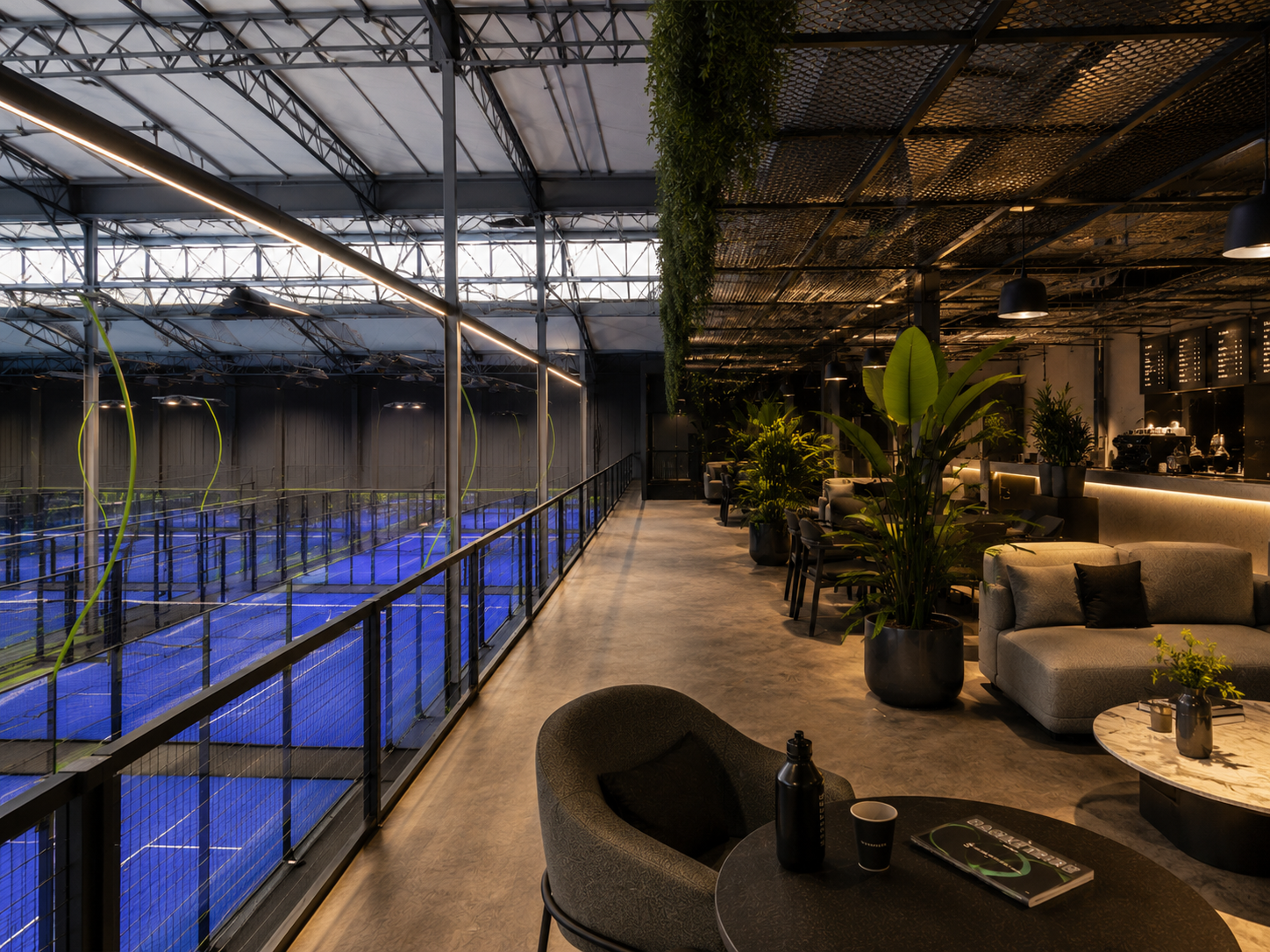
The padel club stripped the model back to its functional core: a space to play, a space to gather afterward, and a mechanism for meeting the same people repeatedly until they become your people. Padium operates across two London sites. Padel Social Club runs eight courts in Canary Wharf. Racketeer is London’s largest indoor padel venue. None of them are carrying dead space.
The Thirty-Second Read
You can tell the difference between a premium padel club and a mid-market padel venue within thirty seconds of arriving, without consciously analysing it.Premium is something like pale timber, terrazzo, linear lighting. The cafe serves oat milk cortados and protein-forward salads. The changing rooms have Aesop products. The aesthetic is doing exactly what club interiors have always done, communicating who the space is for before a word is spoken, but now it is Padel based.
When Prada released a padel-specific capsule collection in March 2026 and Versace followed in May, the confirmation was complete. Padel had acquired the visual language of a luxury leisure category, and the premium clubs in London were already operating inside it. Worth noting: the visual code separated from frequency of use long before the participation numbers caught up. A woman buying a Prada padel skirt is not necessarily buying it for performance. She is buying entry into a specific social and aesthetic register, which is exactly what people have always been buying when they joined a members’ club.
The mid-market venue has synthetic turf, fluorescent lighting, and vending machines. The premium club has sand-infused turf, natural light where possible, and staff who understand that the experience begins when you walk through the door. We can see that the operational difference is marginal, but the perceptual difference is total.
The Entry Mechanism
The traditional Members club sorts through application, interview, and sponsor. The padel club sorts through booking behaviour, skill level, and the social graph that forms around regular players. When you book the same court time every week, you start recognising the same faces. When you join a league, the network expands in a structured way, and typical first questions are not where you went to university, and this is a considerably more honest sorting mechanism and a faster one.
The gender composition reflects this. Padel is a doubles game, less physically demanding than tennis, less spatially isolated than squash, with a shorter learning curve and longer rallies. Women are adopting it at rates comparable to men. The sport has slotted into the weekly routine in the structural position previously occupied by a morning gym class or a midday swim, with one significant difference that it is social by default. You do not have to engineer the conversation, leading to multiple premium London clubs reporting women as the majority of weekday daytime bookings.
Six Weeks to Embedded
A traditional members’ club takes six months to a year before you feel genuinely embedded in its social architecture. The padel club compresses this to approximately six weeks. You join, you book a court, you meet three other players, you book again, the same faces appear, you exchange numbers, and a regular group forms before you have had time to question whether it will. The sport accelerates everything because it requires coordination, which is quite fantastic. You cannot play alone, you need three other people at the same skill level who are free at the same time, and that requirement builds community faster and more naturally than any programme of wine evenings could.
Most premium clubs run weekly leagues, monthly social tournaments, and beginner courses that route new members into the existing player base. Racketeer runs a women-only league on Wednesday evenings. Padel Social Club hosts quarterly member tournaments with bracket play and a post-match dinner. The format is borrowed smoothly from the private members’ club playbook and delivered at a fraction of the cost, because the sport itself is the programming.
What the Waiting Lists Are Actually Telling You
The premium padel club identified the social and community functions of a members’ club and delivered them at a fraction of the cost, without losing the perceptual value. You get regular interaction with the same group of people, a visually coherent environment that telegraphs taste and discretion, and a structured social calendar. The waiting lists are not evidence that the demand was always there, sitting in front of the wrong product.
The traditional club did not lose these women, it just never quite had them.