
How to Travel for Rest: The New Approach to Wellness Vacations
The wellness travel market is approaching $1 trillion. Most of the women driving that figure will return from their carefully selected, expensively booked holidays still tired.
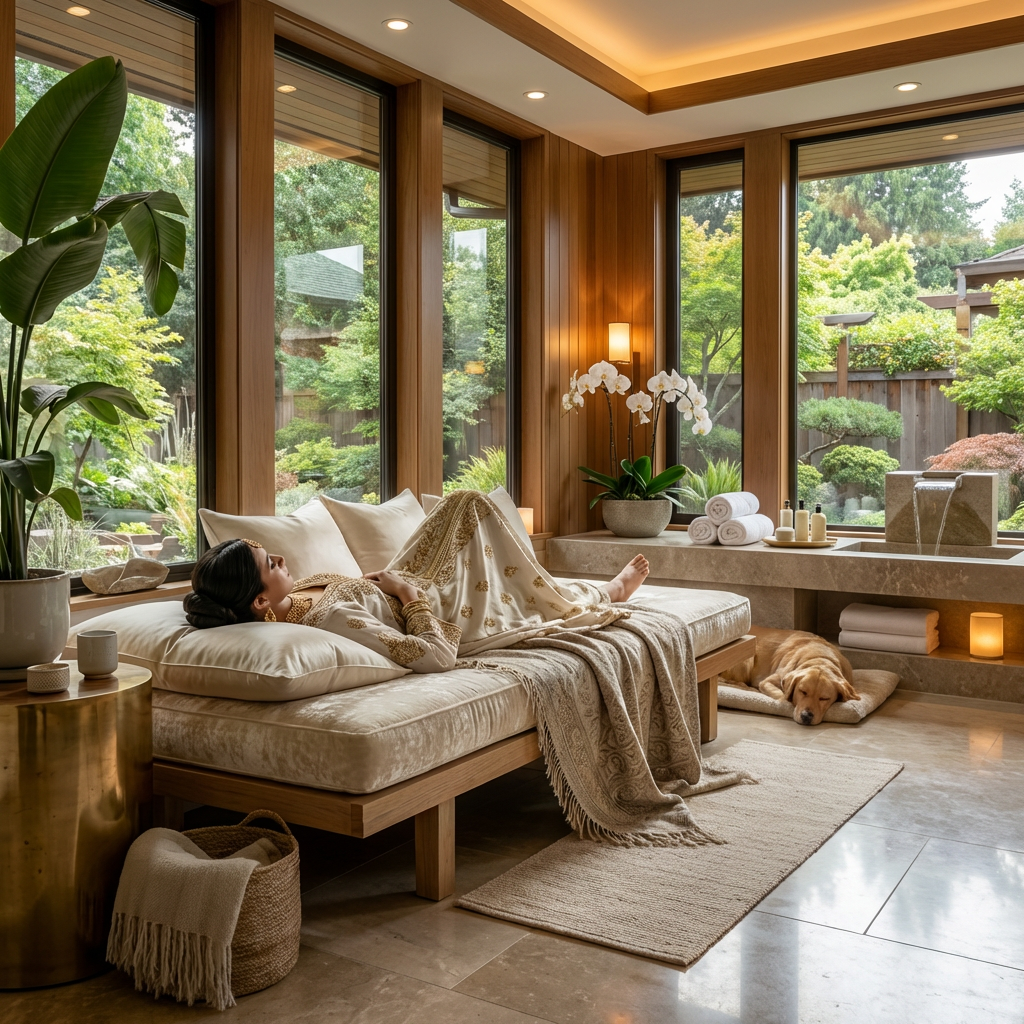
At some point in the last three years, the aspirational holiday shifted. Not its location, not its price point — those have both continued their reliable upward trajectory — but its stated purpose. According to Hilton's most recent annual trends survey, the primary motivation for premium travel in 2026 is rest and recharge. Not the landmark, not the restaurant, not the content. Rest. The wellness travel market is now approaching $1 trillion globally, and the majority of the women driving that figure will return from their carefully selected, expensively booked, beautifully photographed holidays still tired.
This is not a cynical observation. It is a structural one. Rest, it turns out, has an architecture — and most people are not building it correctly.
The Problem With Rest as Earned Reward
The cultural framing most of us inherited positions rest as something that follows sufficient effort — the holiday after the difficult quarter, the long bath after the difficult day, the sleep-in earned by the week that nearly broke you. There is emotional logic to this. There is not much psychological logic to it. Recovery research is fairly direct on the point: restoration is not primarily a function of time elapsed or suffering endured. It is a function of the conditions in which recovery happens and, critically, the degree to which the person recovering has mentally disengaged from the demands that depleted them.
A week in a peak-season hotel, packed with activities, running on social performance, photographed thoroughly, is not rest. It is stimulation with better weather. It may feel like a reward — and rewards have their place — but it will not return you to work in a materially different cognitive state from the one you left in. The research distinguishes between restoration, which means returning to a previous baseline, and something more interesting: a recovery that produces a genuinely higher functional state than the one you arrived with. The second outcome requires specific conditions. Most holidays are not those conditions.
What the Hospitality Industry Has Understood
The luxury end of hospitality has read this shift with reasonable accuracy, even if its solutions occasionally drift toward theatre. Six Senses London — opening at The Whiteley in April — is built around clinical recovery: a Biohacking Recovery Lounge, guided breathwork, personalised protocols. Hilton's new sleep programme addresses temperature, blackout infrastructure, and pre-sleep wind-down. The Waldorf Astoria New York has opened the largest Guerlain spa in the world, with an arctic snow cave designed for nervous system regulation. The language across all of it is consistent: recovery, restoration, regulation. The industry has diagnosed the condition and is now selling, with considerable enthusiasm, the cure.
What it cannot sell is the decision to actually use it. A woman who arrives at a clinical wellness hotel and spends three days working from the lounge, answering emails between treatments, and leaving for dinner before the guided breathing session has purchased the environment without purchasing the outcome. The environment is a necessary condition. It is not sufficient. That part sits with the person inside it.
"The environment is a necessary condition. It is not sufficient. That part sits with the person inside it."
The Architecture of Deliberate Recovery
Sports science has developed a more rigorous framework for this than the wellness industry tends to acknowledge. The distinction between passive recovery — simply stopping — and active recovery — deliberate interventions designed to accelerate return to optimal state — is well established in athletic periodisation. Physical fatigue responds reasonably well to passive recovery within a certain range. Cognitive and emotional depletion, which is the primary form of exhaustion most professional women are managing, responds better to specific conditions: genuine digital withdrawal, physical movement calibrated to regulation rather than exertion, and time spent in environments that require attention without demanding effort.
That last category is worth dwelling on. Attention Restoration Theory — developed by environmental psychologists Rachel and Stephen Kaplan — identifies environments that produce involuntary fascination as the most reliably restorative. Natural landscapes, quiet cultural spaces, slow environments without social demands. The brain continues to process, but without the directed effort that depletes it. This is the actual mechanism behind the instinct to sit near water, to walk slowly through a market, to want a view you can look at without doing anything about it. It is not romanticism. It is how cognitive recovery works, and it is why the most restorative environments tend to be the ones with the least happening in them.
Structuring Travel Around Recovery
The practical application is mostly a set of decisions made at the booking stage rather than inside the trip itself. The destination selected for environmental quietness rather than social cachet. The schedule built with genuinely unbooked time — not as an oversight, but as the point. The property chosen because it was designed for recovery rather than because it photographs well, which are not always the same property.
Secondary cities are increasingly compelling here for reasons that go beyond avoiding crowds. Porto, Lyon, San Sebastián, and Bologna all offer the cultural density that makes a destination feel worthwhile alongside the environmental quietness that actually delivers cognitive restoration. There is also, if one is being direct about it, a relief in choosing somewhere that does not require social justification. Nobody needs to explain a week in Lyon. The absence of the performance layer is itself a form of recovery.
The clinical wellness membership model — Lanserhof at The Arts Club, Six Senses Place, EQX ARC — is doing something useful in its framing: positioning recovery as professional maintenance rather than reward. You do not go to Lanserhof because you have earned a treatment. You go because the maintenance of cognitive capacity is a professional requirement, and this is where that maintenance happens efficiently. That repositioning changes what gets prioritised and, more importantly, what does not get cancelled when the quarter becomes difficult.
What Actually Changes
The women who approach rest as a strategic input tend to travel less frequently and more deliberately. They are more specific about environment — quieter properties, shoulder season windows, destinations chosen for restorative quality rather than social legibility. They protect unstructured time within travel with the same firmness they protect meetings. And they tend to return with a different quality of attention, which was always the actual output being sought.
The hospitality industry is correct that recovery is the dominant driver of premium travel in 2026. What it cannot engineer is the understanding that recovery is preparation, not compensation. One produces a woman who returns to her work restored. The other produces a woman who returns to her work having been somewhere nice.
The distinction between those two outcomes is not a function of where you went or what you spent. It is a function of what you understood you were doing when you got there — and whether the trip was structured to produce it. Rest that is treated as a strategy looks different from rest that is treated as a reward. It is planned in advance, protected during, and evaluated afterwards by one question: did I return with more than I left with?
Most trips answer no. The ones that answer yes are rarely the most impressive to describe at dinner.