A Knightsbridge Club Capped Membership at 150 and Sold Out Anyway
One hundred and fifty. That is the entire membership ceiling at Leréi, the women-only wellness and longevity club that opened in Knightsbridge this August, and more than sixty per cent of those places had already been claimed before the doors did. Subscriptions start at £1,000 a month. There is no version of the offer that scales past the number 150, and the operators appear to have priced that constraint in from the beginning rather than treating it as an unfortunate limit on growth.
Most wellness openings this year have led with amenities. Leréi has led with scarcity, and the market has answered before a single review has been written.
The Number That Is Doing the Real Work
A member cap is a familiar device in club design, but Leréi's version is unusually explicit about what the cap is for. The stated intention is to preserve discretion, service quality and demand tension simultaneously, three things that normally trade off against each other as a membership grows. Most operators solve that tension by adding tiers, a cheaper entry point beneath the premium one, more seats sold at a lower margin per head. Leréi has instead fixed the ceiling and let price do the filtering, which produces a different kind of room. Everyone inside paid the same admission, and everyone inside knows exactly how few other people were allowed to.
What the Membership Actually Buys
The offer is built around genomic testing delivered through a partnership with Precision Health Clinics, positioning the club's opening proposition as clinical rather than aesthetic. From there it extends into NAD+ therapy, red-light fitness classes using Bon Charge mats, aerial yoga, sound baths and Lagree Fitness Method sessions, alongside advanced facials, Korean glass-skin hydrafacials and phototherapy treatments. Guests who are not members pay roughly £100 more per treatment than members do, a spread wide enough to make the membership fee read as a discount on frequent use rather than a fee for access alone.
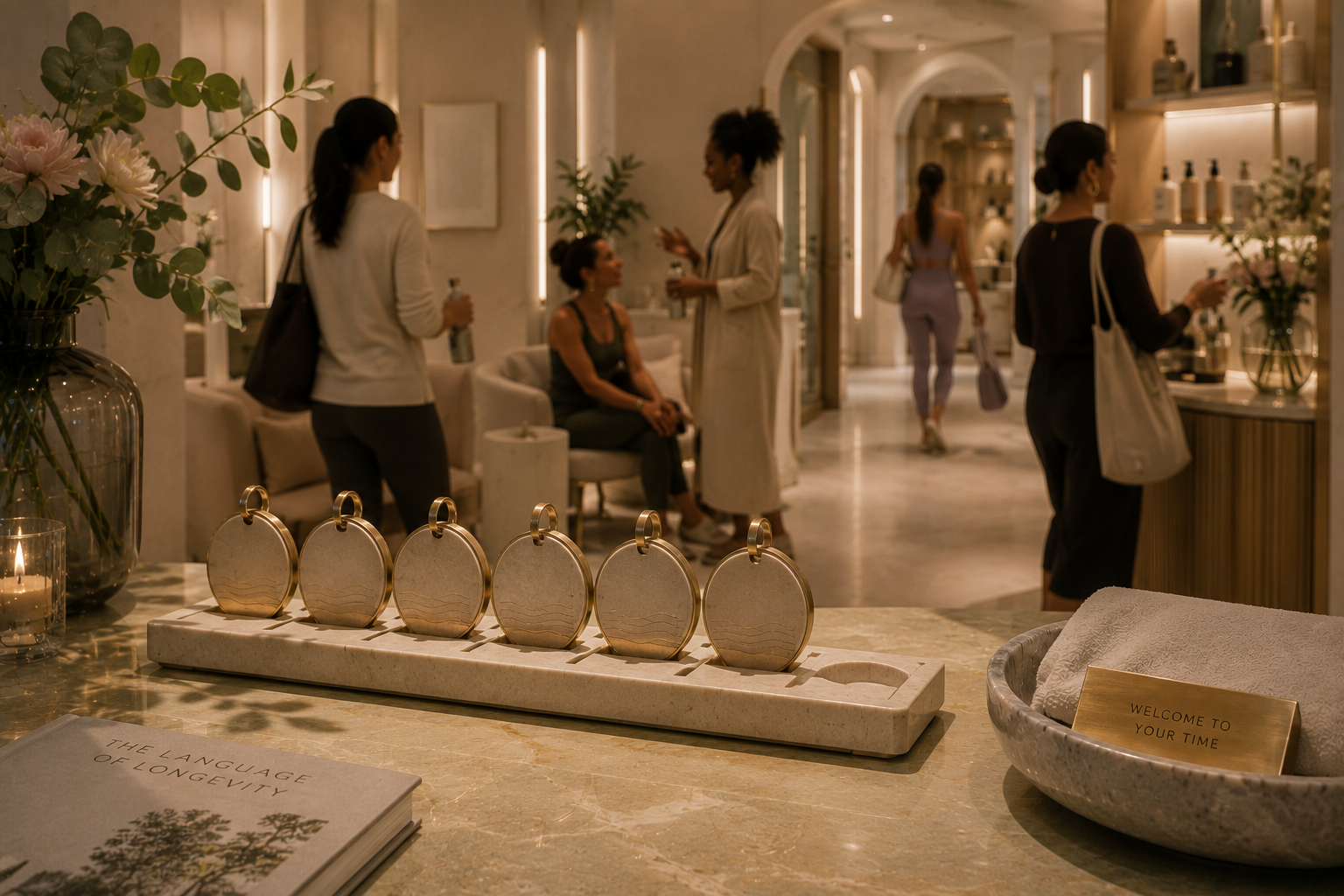
The interior, designed by the Italian firm Visionnaire, is organised around five stated pillars: renew, restore, replenish, reconnect and revitalise. It is worth noting because the specificity is doing more signalling work than a generic wellness-branding exercise would. A named diagnostic partner and five named pillars read as a considered proposition rather than a marketing wrapper applied after the fact.
Who the Club Is Actually For
Leréi's own language is unusually precise about its target member, naming GCC families, Turkish and Lebanese communities, American and European expatriates, and the diplomatic community specifically, rather than reaching for a generic high-net-worth descriptor. This is not incidental. Knightsbridge already concentrates exactly these communities, and a club built around genomic testing, longevity science and discretion is a proposition that reads differently to a diplomatic spouse relocating for a posting than it does to a British executive who happens to live nearby. Building for a named set of cultural and mobility contexts, rather than income alone, is a more precise read of who is actually moving through premium London than the usual aspirational-luxury framing manages.
The Comparison That Clarifies the Model
Six Senses Place, the members' club attached to Six Senses London, runs an open but tiered structure priced from roughly £3,000 up to £37,000, a spread wide enough to admit almost anyone willing to pay at the entry point and let the higher tiers do the exclusivity work instead. Leréi has taken the opposite route: one price, one gender, one hard number on total membership. Both models solve the same underlying problem, how to sell scarcity at scale, but they solve it through entirely different mechanisms. Six Senses lets price stratify the room. Leréi lets the cap do it, with price acting mainly as the filter for who applies in the first place.
Neither model is obviously superior. What the comparison actually shows is that capped-membership scarcity and tiered-access scarcity are now both live, credible strategies operating in the same city within months of each other, aimed at overlapping but not identical audiences.
What a Number Like 150 Signals About Access Generally
A hard cap is a different kind of promise than a price tag. A price tag says a service is expensive. A cap says a service is finite regardless of what anyone is willing to pay once the number is reached, which is a stronger and more legible signal of exclusivity than cost alone has ever managed. It also means the sixty per cent already claimed at launch functions as its own piece of evidence. The club did not need to build demand after opening, because the ceiling itself generated the demand before the first member walked in.
For a market that has spent the past several years selling wellness through amenity lists, saunas, pools, contrast bathing, treatment menus that read like hotel brochures, Leréi's opening bet is that the amenities matter less than the number attached to who gets to use them. Genomic testing and NAD+ therapy are increasingly available elsewhere. A membership capped at 150 and already two-thirds gone is not.
The Read Worth Carrying Forward
What Leréi actually tests is whether scarcity itself, named explicitly and enforced numerically, is now a more credible premium signal than any individual treatment on the menu. Sixty per cent claimed before opening suggests the answer, at least for this specific set of members in this specific postcode, is yes.
The room is not full yet. It is close enough that the remaining places are the more interesting story than the ones already taken.